
My Favorite Bottle of 2025: “Sleeping Beauty”
My Favorite Bottle of 2025: “Sleeping Beauty”
Once a year, in January, I will single out one wine that rises above all others—a bottle that doesn’t just taste exceptional, but creates a moment, an experience, something that lingers long after the last glass is empty. The past year offered no shortage of contenders, yet the wine that claimed the crown was an unlikely heroine: a quiet, unforgotten bottle that had been sleeping patiently for decades.
Let me tell you how this Sleeping Beauty came into my life.
Once upon a time—quite literally—there was a very generous man who donated several thousand dollars’ worth of vintage wine to my boys’ school auction each year. The first time I attended, my jaw dropped. This wasn’t just generosity; it was a window into a deeply thoughtful and remarkably diverse cellar. Over the years, I managed to bring home many special bottles—some already enjoyed, others still maturing peacefully in my cellar. Italy, Spain, Oregon, Washington, California—each auction felt like a global tour.
I tried to win as many lots as I could reasonably afford, which required a fair amount of frantic, last-minute bidding. While many attendees browsed gift certificates and keepsakes, I spent the entire evening researching unfamiliar labels and vintages, hunting for hidden gems. I was a kid in a candy shop—except this candy required a corkscrew.
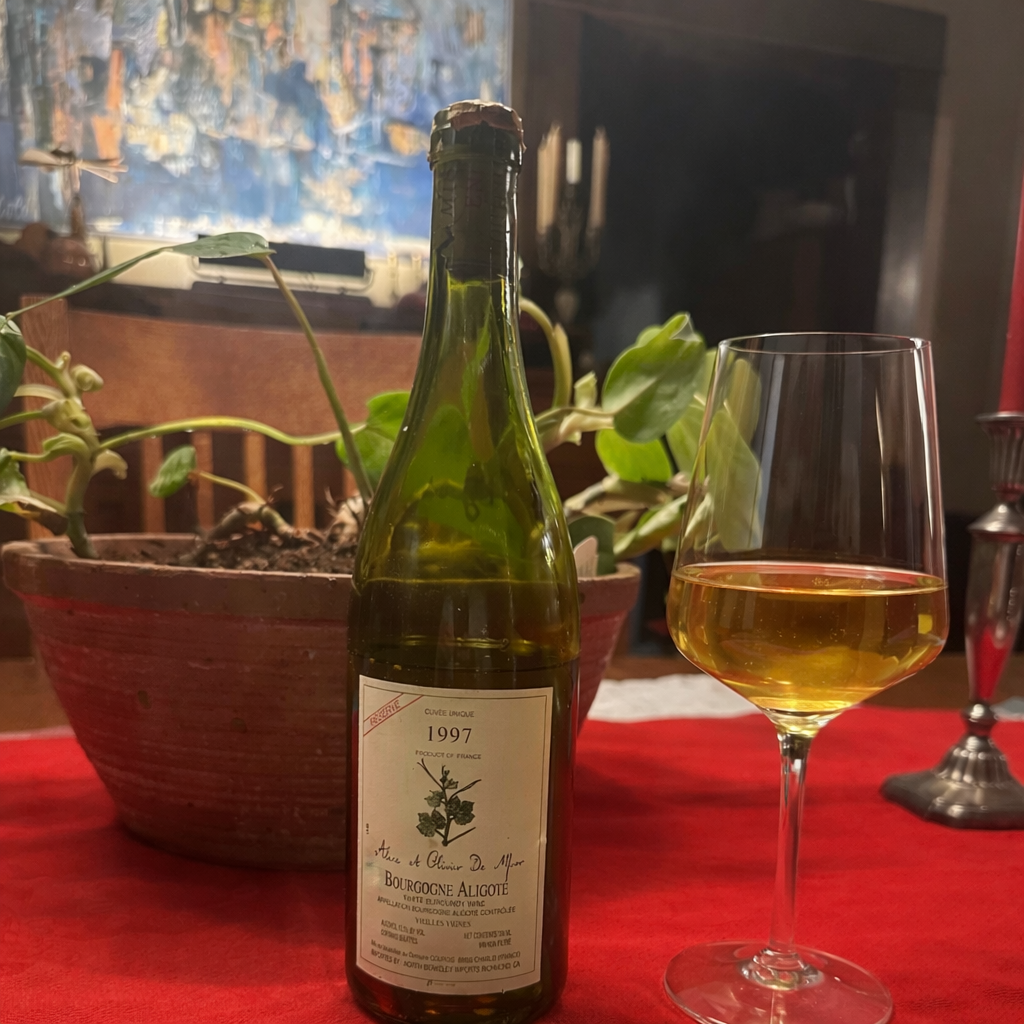
At one particular auction, a two-bottle lot stopped me in my tracks: a 1997 Reserve White Bourgogne Aligoté from France. Three thoughts came immediately to mind.
First: 1997 is our wedding anniversary.
Second: That is a beautiful bottle.
Third: This wine is either going to be terrible… or fascinating.
If you’re not familiar with Aligoté, it’s often considered the lesser-known sibling of Chardonnay in Burgundy, especially when compared to Chablis. In both France and the U.S., it’s typically appreciated for its fresh citrus notes and minerality and is rarely intended for long-term aging. Unlike high-end Chablis or structured red Burgundies, Aligoté is usually enjoyed young. This bottle, however, had already been waiting nearly three decades.
Curiosity got the better of me. I researched the producer—Domaine De Moor—and discovered a small, boutique husband-and-wife operation, both trained enologists, located just three miles from Chablis. They planted their vineyard in 1995, which immediately raised an important question: this 1997 Reserve couldn’t have come from young vines. New plantings need years before producing usable fruit, and decades before yielding grapes worthy of a “Reserve” designation.
The answer lay in their history. This wine was made from an Aligoté parcel planted in 1902. Old vines—especially Aligoté—can produce remarkably complex wines, and their naturally high acidity offers the possibility of long cellar life. With great soils, skilled hands, and a strong vintage, hope replaced skepticism.
But hope doesn’t guarantee greatness. So the question remained: Would it still be alive?
The Experience
The moment of truth arrived on our 28th wedding anniversary—an occasion that demands a meaningful bottle. We stayed in, as my wife cooks meals that rival the best restaurants in our area (and I have grown weary of the restaurant industry’s 300% wine markup on bottles they didn’t produce). Instead, we visited our excellent local fish market and gathered ingredients for a French-inspired seafood stew.
As always, the wine was chosen first. The menu followed.
While my wife cooked, I carefully peeled away the wax seal—already a promising sign. The cork, however, had clearly given its all. It crumbled the moment my opener pierced it. Accepting defeat, I removed what I could and gently poured the wine through a fine mesh strainer to catch the fragments.
As the stew simmered, I stole a quiet sip—and, naturally, added a splash to the pot.
I was prepared for a challenging wine: oxidative notes, tired acidity, a short or hollow finish. After all, this bottle had been resting for 28 years. Instead, I found something extraordinary.
The color was a mature straw, glowing but not dull. The nose was clean—no oxidation, no funk, nothing out of place. The wax seal had done its job, limiting oxygen transfer over the decades. On the palate, the wine was still vibrant, with refreshing acidity, layered stone fruit, and a surprising caramel-like confection note on the finish. It was smooth, complex, and remarkably alive.
The pairing with the stew elevated both—the wine sharpened the dish, and the dish deepened the wine. Together, they created a moment that will stay with me far longer than the label itself.
This bottle was a testament to proper wine stewardship. Thanks to the generous gentleman who cellared it with care for 20 years—and my own 8 years of careful storage—it proved what well-built cellars and thoughtful patience can achieve. As I write this, I’m smiling because this was just the first of the two bottles of 97–Another experience awaits.
So the next time you come across a special bottle, treat it with respect. Lay it down. Let it sleep. Plan a meal worthy of its awakening. And most importantly, share it with someone you love.
Because sometimes, the most beautiful wines are the ones that simply needed time to wake up. 🍷.
